ChatGPT has carried text-based ads for a while now, but OpenAI just confirmed the next step: visual ads, shown while the app is actually generating an image for you. The announcement landed on October 5, 2026, alongside a fairly significant expansion of how advertisers measure what those ads actually do.
For marketers, this one is worth reading past the headline. The visual format is the attention-grabbing part, but the real story is the measurement and attribution infrastructure OpenAI is quietly building underneath it — the kind of plumbing that decides whether ChatGPT becomes a serious ad channel or stays a curiosity.
What OpenAI Actually Announced
OpenAI framed the update around a simple number: ChatGPT now reaches 1.2 billion people every week, which the company is calling the largest AI-native consumer platform in the world. Advertising, in OpenAI’s own words, is how it funds bringing AI access to that scale of audience without relying on subscriptions alone.
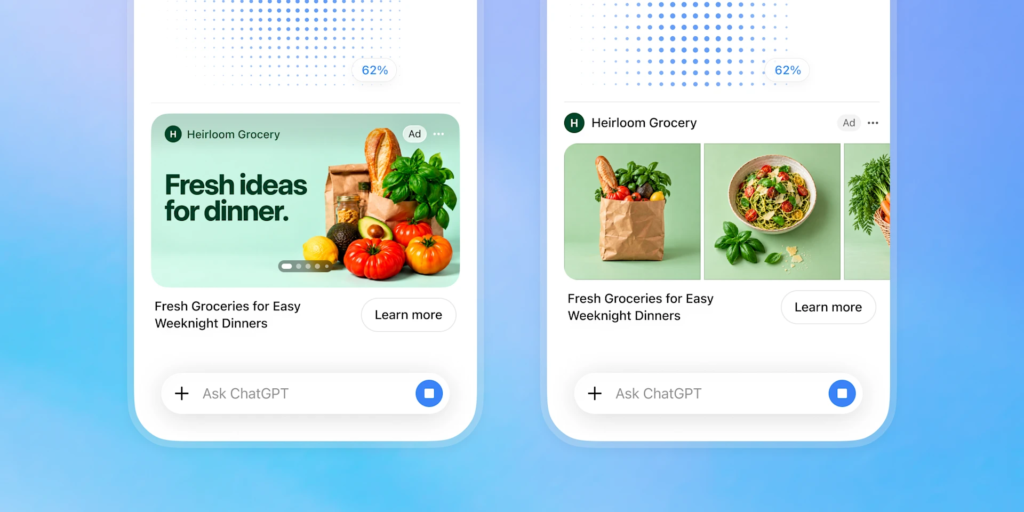
The headline feature is a new visual ad format that appears during image generation in ChatGPT. Instead of a line of sponsored text, these ads use product inspiration, usage imagery, or lifestyle visuals to help someone picture how a product or service might actually fit into their life. OpenAI is positioning it as a more natural way to discover a brand than a plain text link, especially inside a feature where people are already thinking visually.
Who Will Actually See These Ads
The test is narrower than the framing might suggest. Visual ads will initially roll out only to Free and Go plan users generating images in ChatGPT, starting in the US with a limited group of advertisers later this month. Plus, Pro, Business, Enterprise, and Edu users are excluded entirely, consistent with how OpenAI has handled its existing text ads.
OpenAI has also been specific about the guardrails: ads will carry a clear label, stay visually separate from the image a user actually generates, and won’t influence what ChatGPT says in its responses. That last point matters for trust — it’s the same line OpenAI has repeated with every ad format it’s introduced so far, and it’s clearly meant to head off the obvious concern that paid placements could start shaping ChatGPT’s actual answers.
The Bigger Move: Measurement Infrastructure
The visual format is one headline, but the bulk of the announcement is really about measurement. OpenAI added integrations with Hightouch, Tealium, and LiveRamp, letting advertisers pipe conversion data from systems they already use straight into ChatGPT Ads instead of building something new from scratch.
On top of that, OpenAI is now working with a long list of attribution partners spanning web and app tracking, including AppsFlyer, Branch, Singular, Kochava, Airbridge, Tenjin, Adjust, Triple Whale, DV Rockerbox, and Northbeam. For performance marketers, several of these names will already be familiar from running campaigns on Meta, Google, or TikTok, which lowers the barrier to actually testing ChatGPT Ads rather than treating it as a completely separate skill set.
OpenAI is also testing incrementality measurement — essentially, proving an ad’s impact isn’t just correlation — through geo-based experiments with partners Haus, Measured, and WorkMagic. The company was upfront that this work is still early rather than a finished product.
Early Numbers Advertisers Are Already Citing
A handful of early results were shared alongside the announcement, credited to specific measurement partners rather than OpenAI itself. According to DV Rockerbox, WeightWatchers saw a cost per acquisition on ChatGPT Ads roughly 15% lower than its blended paid-search benchmark. WorkMagic reported statistically significant lift for wellness brand Dose, with two-thirds of incremental purchases coming from entirely new customers. And Triple Whale reported that the large majority of Portland Leather’s visitors arriving via ChatGPT Ads were new to the brand.
These are early, partner-reported numbers from a small set of advertisers, not an industry-wide benchmark, and should be read that way rather than as a guarantee of similar results elsewhere.
Brand Safety Gets Its Own Spotlight
OpenAI also used the announcement to address something advertisers have been asking about since ChatGPT Ads launched: whether a brand’s ad could end up sitting next to an inappropriate or sensitive conversation. The company says its placement guardrails are built to keep ads out of emotionally vulnerable or otherwise unsuitable contexts, with automated review and human oversight layered on top.
More notably, OpenAI is piloting independent brand suitability evaluations with DoubleVerify and Integral Ad Science — two names any media buyer will already recognize from running campaigns across the open web. Both companies get to assess how OpenAI’s safety standards hold up in a controlled testing environment, without being given access to actual user conversations, which is OpenAI’s way of trying to offer third-party verification without compromising conversation privacy.
Why This Matters Beyond OpenAI
Step back, and this announcement reads as part of a bigger shift: AI chat interfaces are becoming genuine advertising surfaces, not just research tools. ChatGPT reaching 1.2 billion weekly users puts it in rare company, and building out measurement infrastructure this deliberately — attribution partners, incrementality testing, independent brand safety audits — signals OpenAI wants to be taken seriously as an ad platform competing for the same budgets currently going to Google, Meta, and Amazon, not treated as an experimental side channel.
What This Means For Indian Marketers
For brands and agencies working in India, the test itself is US-only for now, so there’s no immediate campaign to launch. But the attribution partner list is the detail worth paying attention to early. Several of the names OpenAI just added — AppsFlyer, Branch, Adjust, and Kochava in particular — are already standard tools inside Indian mobile marketing stacks for app-install and e-commerce attribution. That overlap means that when ChatGPT Ads does expand to more markets, Indian performance marketing teams won’t be starting from zero; the measurement layer they already rely on for Meta and Google campaigns will likely plug into ChatGPT Ads with relatively little extra setup.
The more useful move right now is watching rollout timing and eligibility rather than waiting to react once it’s already live elsewhere. Brands that get their attribution and conversion tracking in order now, using tools already on this list, will have a real head start whenever OpenAI opens visual ads beyond the US.
FAQs
What did OpenAI actually announce about visual ads in ChatGPT and the supporting measurement infrastructure?
OpenAI announced a new visual ad format that appears during image generation in ChatGPT, along with a broader measurement infrastructure. This includes integrations with Hightouch, Tealium, and LiveRamp to pipe conversion data into ChatGPT Ads, and a range of attribution partners such as AppsFlyer, Branch, Singular, Kochava, and others to measure performance. They also highlighted work on incrementality testing and independent brand safety evaluations.
Who will be able to see these visual ads initially?
Initially, visual ads will roll out only to Free and Go plan users generating images in ChatGPT, starting in the US with a limited group of advertisers. Pro, Business, Enterprise, and Edu users are excluded at this stage, consistent with how OpenAI has handled its existing text ads.
How will attribution and measurement for ChatGPT Ads work?
Advertisers can feed conversion data from their existing systems into ChatGPT Ads through integrations with measurement partners. OpenAI is also working with a broad list of attribution partners for open-web and app tracking, and is testing incrementality measurements through geo-based experiments with partners like Haus, Measured, and WorkMagic.
What about brand safety and ensuring ads don’t influence ChatGPT’s responses?
Ads will have a clear label and stay visually separate from the image a user actually generates. They will not influence what ChatGPT says in its responses. OpenAI is piloting independent brand suitability evaluations with DoubleVerify and Integral Ad Science to verify safety standards without exposing user conversations.
What does this mean for marketers outside the US, such as in India?
For India, the test is US-only for now, but many attribution tools listed (AppsFlyer, Branch, Adjust, Kochava, etc.) are already common in Indian mobile marketing stacks. When ChatGPT Ads expands to other markets, the existing measurement tools are likely to plug into the platform with relatively little extra setup, so advertisers should watch rollout timing and eligibility and prepare their attribution data accordingly.


